Sicilian Parliament
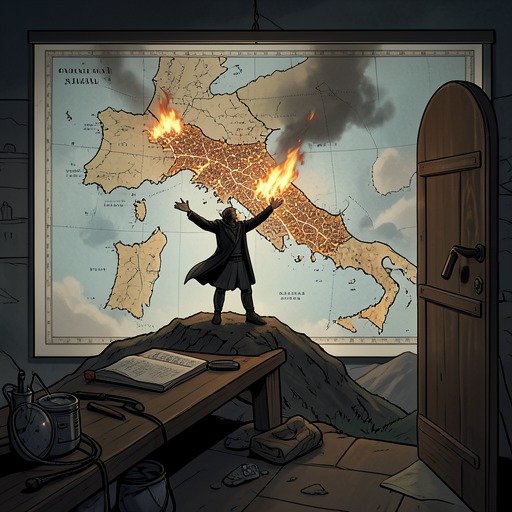
The Florios of SicilyThe Sicilian Parliament represents both a constitutional claim to self-government and the vulnerability of that claim to changing regimes. Restored during uprisings against Bourbon rule, it becomes a focal point for efforts to recover Sicily’s political autonomy; its fortunes are tied to the island’s struggles over taxation, administration, trade, and sovereignty.
Origins and Constitutional Authority
In 1799, the Neapolitan Republic’s establishment and collapse brought the Bourbon monarch Ferdinand IV and Maria Carolina to Palermo as refugees. The upheavals of the following years again displaced Ferdinand: after Napoleon’s victory at Austerlitz and the installation of Joseph Bonaparte in Naples, the king fled to Palermo under British protection, while continuing to rule Sicily. These shifts made the island a refuge and a strategic political center without resolving who would govern it.
A revolt over income tax in 1812 led the Sicilian government to promulgate a constitution modeled on the Westminster system. It sharply curtailed the Bourbon king’s power, abolished fiefdoms, and proposed reforms to government. The constitutional project aimed to modernize Sicilian society and strengthen ties with Britain, which had an interest in keeping the island independent. The Parliament’s constitutional significance therefore lay not only in representation, but in its challenge to royal authority and in the institutional changes attached to that challenge.
Restoration and Suppression
The constitutional settlement was overturned in December 1816, when the king united Naples and Sicily under the name Ferdinand I, King of the Two Sicilies, and annulled the 1812 constitution. The consequences were administrative as well as symbolic: state offices, customs, and military command came under Neapolitan control, while Palermo lost political independence. Heavier taxes, restrictions, and new constraints on trade compounded the loss of self-government and deepened an already severe economic stoppage.
The novel presents this loss as a source of durable resentment, but also emphasizes the divisions that weakened resistance. Palermo, Messina, Trapani, and Catania were at odds with one another, despite their shared hostility to rule from beyond the Strait of Messina. In 1820, aristocratic opposition and secret societies helped fuel another revolt. The uprising forced Prince Francesco to take refuge in Naples and brought the Sicilian Parliament back, restoring the constitution. Yet the independence-seeking government faced internal discord and Bourbon resistance. The monarchy was restored in November, returning Sicily to Neapolitan control; in March 1821, Austrian forces entered Naples on Ferdinand I’s behalf and defeated the insurgents. Their occupation lasted until 1827.
Political Authority and Commercial Life
The Parliament’s repeated rise and suppression matter in the novel because political power is experienced through material arrangements. After the 1816 settlement, Neapolitan officials controlled customs and state offices, while restrictions on trade helped bring Palermo’s already faltering economy to a halt. During later political turmoil, customs could again become a point of immediate disruption: in one crisis, outgoing ships were blocked amid confusion over a provisional government, leaving merchants and seamen gathered at the Customs House as armed soldiers held the entrance.
The same entanglement of sovereignty and commerce recurs during the 1848 revolution. Vincenzo Florio tells Giulia that he has purchased rifles in England for the revolutionary committee, while the Sicilian government proclaims a kingdom without finding a king willing to take the crown. He describes the reapplication of the 1812 constitution as lacking a viable point of reference, and notes that ships have been requisitioned and the firm pressed into lending money. The revolutionary authorities also take the Sicilian Steamship Company’s Palermo to transport troops. For Vincenzo, political commitments thus arrive as demands on the fleet, capital, and trade he has spent a lifetime building.
Successive Regimes and the Parliament’s Limits
The novel sets the Parliament’s constitutional promise against repeated changes of government. Ferdinand II’s accession in 1830 brings initiatives in infrastructure, engineering, railways, military shipbuilding, electrical street lighting, pensions, and sulfur exploitation. These developments show that administrative modernization could occur under Bourbon rule even as the older conflict over Sicilian autonomy remained unresolved.
In 1860, Vincenzo again confronts the costs of a regime change. He reports that the Bourbons retained three of the firm’s five steamers for troop transport and later sought to fine him over interrupted mail distribution, despite the disruption and damage to the company. His anger also turns toward the Piedmontese: he calls Sicily’s annexation a pretense and objects that the Bourbon treasury has been taken to Piedmont to finance the campaign. By this point, the political question extends beyond the Parliament’s restoration: successive authorities claim the island’s resources and transport while leaving Sicilian merchants to bear the consequences.
Significance
The Sicilian Parliament is not portrayed as an institution able to secure autonomy by its existence alone. Its return in 1820 briefly reactivates constitutional government, but civic divisions and external military intervention defeat that effort. Across the novel’s political episodes, changes in constitutional form repeatedly alter who controls offices, customs, ships, taxes, and money; the resulting pressures enter the Florios’ ledgers and decisions. The Parliament therefore stands for a contested ideal whose practical force depends on more than law: it requires political unity and the power to withstand the states and armies that seek to govern Sicily.